WA Licensed (01) Electrical Contractor · Lic #EC-SPOKEV*821JA
Serving All 30 Spokane Neighborhoods & Spokane Valley (509) 800-4136
⚡ DIAGNOSTIC & EMERGENCY REPAIR SPECIALISTS · SPOKANE, WA

EV Charger Troubleshooting Spokane: Tripped Breakers & Faults

Rapid electrical diagnosis and repairs for EV chargers across Greater Spokane. Fix repeated breaker trips, red LED fault codes, overheating plugs, GFCI nuisance tripping, and loose terminal lugs with our licensed Washington (01) master electricians.

  • ✓
    Fast Local Diagnostics: Priority dispatch across Spokane, Spokane Valley, Liberty Lake, Cheney, and Mead for critical EV charging outages.
  • ✓
    Thermal Infrared & Insulation Testing: Pinpoint loose terminal lugs, overheating conductors, and micro-arcing before catastrophic panel failures occur.
  • ✓
    Guaranteed Code Compliance & Safety: Licensed Washington (01) Master Electricians (Lic #EC-SPOKEV*821JA) restoring your charging setup to NEC 625 safety standards.
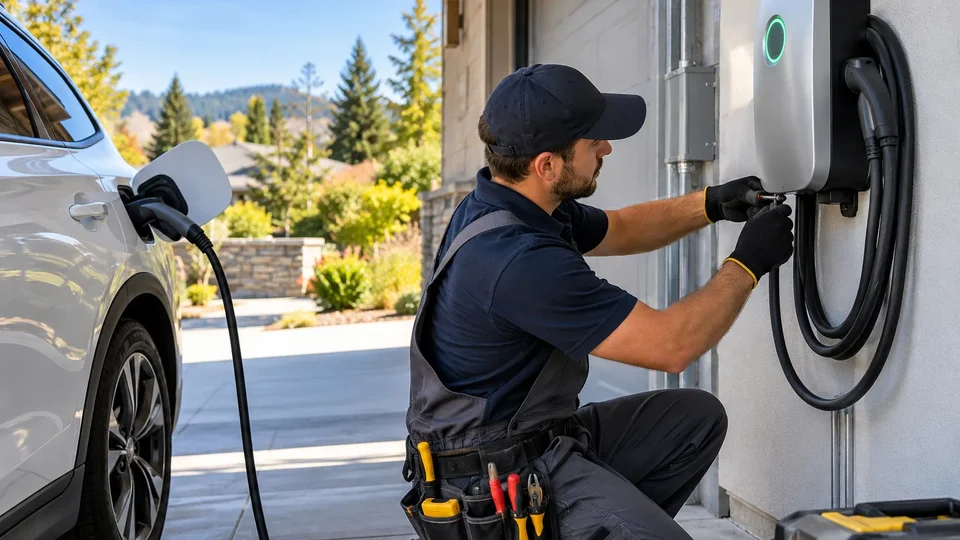
EV Charger Troubleshooting and Electrical Diagnostic Testing in Spokane WA
⚡ WA Lic #EC-SPOKEV*821JA: Licensed Electrical Diagnostic Specialists.

Request Diagnostic Service

Get fast electrical troubleshooting, fault code diagnosis, and upfront repair estimates in Spokane County.
🔒 Licensed Master Electrician dispatch · Calibrated FLIR thermal audit · WA Lic #EC-SPOKEV*821JA

🛡️
WA Electrical Lic #EC-SPOKEV*821JA Licensed (01) General Electrical Contractor
🌡️
FLIR Infrared Diagnostics Pinpoint high-resistance hot spots
🔌
All Major EVSE Brands Tesla, ChargePoint, Wallbox, Emporia
📜
100% Code & Safety Compliant NEC Article 625 & NFPA 70E certified

Why EV Chargers Fail: 5 Common Electrical Breakdown Causes

Electric vehicle chargers are the largest continuous electrical loads in modern Spokane residences. Unlike water heaters or clothes dryers that cycle on and off, EVSE pulls 32 to 48 amps continuously for 6 to 10 hours straight, punishing marginal wiring and uncalibrated connections.

80% Load
Continuous Limit
NEC 625.41 mandates continuous EVSE loads cannot exceed 80% of circuit rating.
140°F+
Critical Hotspot
Terminal lugs with high contact resistance rapidly overheat and oxidize.
60% Faults
Improper Torque
Traced directly to uncalibrated hand-tightening without torque tools.
24–48 Hr
Priority Dispatch
Rapid diagnostic dispatch across Spokane County to restore daily charging.
Circuit Breaker Tripping Under Continuous Overload Test in Spokane Electrical Panel

The Continuous Duty Reality of Level 2 Charging

Most household electrical circuits are designed for intermittent use. A residential oven or air conditioning compressor cycles on for 15 minutes, draws peak current, and shuts off, allowing conductors and breaker thermal elements to cool down.

An electric vehicle charging at 48 amps draws 11,520 continuous watts without pausing. If a terminal lug was torqued incorrectly, if wire gauge was undersized, or if a breaker has internal bimetal fatigue, heat steadily accumulates hour after hour until insulation softens, nuisance trips begin, or catastrophic fire risks develop.

  • ✓
    Bimetal Thermal Fatigue: Repeated heating and cooling cycles weaken older breakers, causing them to trip at lower amperages over time.
  • ✓
    Oxidation on Copper Leads: Overheated copper develops black oxide coatings that dramatically increase electrical resistance and accelerate thermal buildup.

EV Charger Fault Code Decoder: What Those Flashing Lights Mean

Modern Level 2 charging stations incorporate sophisticated self-diagnostic microcontrollers. Use our master diagnostic matrix to identify your fault and understand the required electrical repair.

Brand / Hardware Visual Indicator Root Fault Diagnosis Immediate Action Required Electrical Fix
Tesla Wall Connector (Gen 3) 1 Red Blink Ground wire disconnected or high ground impedance Unplug vehicle immediately Re-torque ground terminal lug; test ground rod resistance with meter
Tesla Wall Connector (Gen 3) 3 Red Blinks Internal high temperature fault (Terminal Overheat) Turn off breaker at panel Disassemble faceplate, inspect copper for oxidation, re-torque lugs to 44 in-lbs
ChargePoint Home Flex Solid Red Ring Hardware fault or ground fault circuit interrupter trip Power cycle breaker once Conduct 1,000V megohmmeter insulation resistance test on branch wiring
Emporia Smart EVSE Flashing Red LED Severe voltage drop under 200V or floating neutral Stop charging; check home lights Verify service entrance voltage balance with Avista Utilities; retorque panel neutral
JuiceBox 40 / 48 Rapid Red Flash Contactor relay welded closed or pilot signal short Switch off breaker immediately Replace internal power relay contactor or convert to direct hardwired station
NEMA 14-50 Receptacle Charring / Odor Loose blade contact resistance in builder-grade outlet Do NOT touch hot plug; trip breaker Replace with industrial Bryant 9450FR socket or convert to direct hardwire

Why Red Blinking Faults Must Never Be Ignored

When an EVSE displays a persistent red fault code, its internal microcontroller has detected an electrical condition that violates safety thresholds. Continuing to reset the breaker without addressing the underlying root cause can permanently damage your vehicle's onboard charger ($2,500–$5,000 repair) or ignite flammable drywall inside your garage.

Our master electricians carry advanced diagnostic tools—including high-precision micro-ohmmeters, calibrated thermal imagers, and digital oscilloscope signal analyzers—to isolate the exact failure point in under 45 minutes.

EV Charger Flashing Red Fault Code Diagnostic Inspection in Spokane WA

Melted NEMA 14-50 Outlets & Burnt Lugs: An Inland Northwest Hazard

Over 60% of emergency troubleshooting calls we receive across Spokane involve melted 240V plug-in receptacles or scorched terminal lugs inside electrical subpanels.

Burnt Terminal Lug and Melted Electrical Receptacle Repair in Spokane Garage

The Flaw in Builder-Grade NEMA 14-50 Sockets

Many residential homes constructed throughout Spokane Valley, Liberty Lake, and North Spokane were outfitted with inexpensive $12 builder-grade NEMA 14-50 receptacles. These outlets utilize light-gauge stamped brass contact prongs engineered for electric kitchen stoves—appliances that draw full power only intermittently for baking.

When an electric vehicle is plugged in, continuous current causes microscopic thermal expansion and contraction. Over months of use, the female contact blades lose clamping tension. High contact resistance generates temperatures exceeding 200°F (93°C), melting the plastic faceplate and fusing the vehicle charging plug permanently into the wall.

  • ✓
    Industrial-Grade Replacement: We install heavy-duty Bryant 9450FR or Hubbell HBL9450A receptacles featuring reinforced glass-reinforced nylon and heavy copper-alloy contact jaws.
  • ✓
    Direct Hardwiring Advantage: Eliminating the plug-in socket completely removes the single most failure-prone component in the entire charging system.
💡 Pro Tip: Hardwiring Eliminates 2 Potential Failure Points: In addition to eliminating the melted socket hazard, hardwiring your EV charger removes the requirement for a costly $120+ GFCI circuit breaker under NEC 210.8(A) and unlocks faster 48A charging speeds (up to 11.5 kW), reducing daily charge times by 25%.

Why Calibrated Torque Screwdrivers Are Mandated Under NEC 110.14(D)

"Hand-tight" is not a legal or safe electrical standard. Under National Electrical Code Article 110.14(D), every terminal screw must be torqued to the manufacturer's exact inch-pound specifications using calibrated tools.

The Physics of Loose Electrical Terminations

When an electrician guesses torque using a standard hand screwdriver, terminal screws are almost invariably either undertorqued (causing micro-arcing and heat buildup) or overtorqued (crushing copper strands and stripping terminal threads).

Under Spokane's winter-to-summer temperature swings (from -10°F to 105°F), conductors expand and contract continuously. If a terminal lug is not torqued to exact manufacturer specs (such as 50 in-lbs for square D breakers or 44 in-lbs for Tesla terminals), the screw backs out microscopic fractions of a millimeter. Electrical current is forced through a shrinking contact patch, generating intense localized heat that chars wiring insulation.

  • ✓
    Certified Calibrated Wrenches: Our master electricians use annually calibrated digital torque tools accurate to within ±2%.
  • ✓
    De-Oxidation Treatment: We apply anti-oxidant joint compound to all terminations to prevent galvanic corrosion and long-term contact degradation.
Calibrated Torque Screwdriver Verifying Terminal Lugs on Spokane EV Charger
⚠️ Critical Warning: Never Attempt to Re-Torque Energized Lugs: Electrical panels carry lethal 240V arc-flash energy. Attempting to tighten terminal screws without fully de-energizing the service panel, verifying zero voltage with a calibrated CAT-III multimeter, and utilizing insulated NFPA 70E safety equipment can cause severe electrical shock or arc-flash explosions.

Nuisance Tripping Explained: The "Dual GFCI" Conflict

Does your EV charger trip the breaker unexpectedly in the middle of the night, leaving you with an empty battery in the morning? You are likely a victim of the notorious Dual GFCI conflict.

📜

The 2020 NEC Mandate

NEC 210.8(A) mandates that all 240V receptacles installed in residential garages must be protected by a GFCI circuit breaker to prevent consumer shock hazards.

🛡️

The Charger's Internal GFCI

All UL-listed Level 2 EV chargers already contain an ultra-sensitive 5mA Class A internal ground fault protection system built into the hardware.

⚡

Harmonic Cross-Talk

The charger's self-test pulse sends high-frequency diagnostic signals down the neutral/ground wire, tricking the panel's GFCI breaker into detecting a false leakage fault.

🔧

The Permanent Code Fix

By removing the receptacle and hardwiring the charger directly to a standard high-quality breaker, you maintain 100% code compliance while permanently eliminating nuisance trips.

GFCI Circuit Breaker Nuisance Tripping Prevention and Direct Hardwire Solution

Why Hardwiring Cures Nuisance Tripping Permanently

When two electronic ground fault monitoring systems are connected in series on the same electrical circuit, they fight each other. In unheated Spokane garages during winter, minute condensation levels or vehicle charging initiation pulses trigger immediate breaker trips.

Under National Electrical Code Article 625.54, hardwired EV chargers are explicitly exempt from upstream GFCI breaker requirements because the charging station's onboard electronic safety interlocks provide superior personnel protection. Converting to a hardwired connection solves 100% of nuisance trips permanently.

Sub-Zero Winter Breaker Trips & Ground Fault Leakage in Spokane

Spokane's freezing winters place extreme thermal and electronic stress on EV charging systems. Here is why faults spike when the thermometer drops below 20°F.

The Winter Battery Pre-Conditioning Load Surge

When temperatures plummet in Eastern Washington, an electric vehicle cannot charge safely while its battery cells are freezing. Upon plugging in, the car immediately activates high-wattage PTC liquid battery heaters (drawing up to 7,000 watts) while simultaneously ramping the onboard battery charger to full output.

If your circuit breaker is mounted in an unheated garage, the breaker's internal thermal-magnetic trip curve shifts. Additionally, winter moisture from snow melting off your vehicle wheel wells can seep into unsealed outdoor conduit junctions, causing microscopic ground fault leakage current that triggers ground fault errors.

  • ✓
    Megohmmeter Insulation Testing: We inject 1,000V DC testing current down branch conductors to verify wire insulation has zero micro-cracks or moisture tracking.
  • ✓
    Ground Rod Impedance Verification: We test your home's grounding electrode system to ensure ground resistance stays well under the 25-ohm NEC threshold.
Ground Fault Error Wiring Resistance Check with Megohmmeter in Spokane

Repair or Upgrade? Choosing the Most Cost-Effective Path

We provide upfront pricing, clear diagnostic reports, and practical repair recommendations without high-pressure upselling.

🔧
FASTEST & SIMPLEST

Component Repair & Retorque

Ideal when wiring is intact but terminal screws loosened or a breaker fatigued. We replace the damaged breaker, trim back oxidized copper, apply de-ox paste, and retorque to exact manufacturer specifications.

Typical Cost: $225 – $450
⚡
THE GOLD STANDARD FIX

Conversion to Direct Hardwire

Eliminates melted outlet risks and dual GFCI nuisance tripping permanently. We remove the 14-50 receptacle, pull fresh conductors directly into the charger terminal block, and upgrade to a 60A breaker for 48A charging.

Typical Cost: $275 – $550
🏗️
LONG-TERM UPGRADE

Circuit & Subpanel Overhaul

Required when existing circuits were dangerously wired with undersized Romex or panels have zero remaining capacity. Includes new EMT conduit, heavy THHN copper, subpanel addition, and City permitting.

Typical Cost: $850 – $1,800+

Our 6-Step Precision EV Charger Diagnostic Workflow

Our licensed Washington master electricians follow a systematic, instrument-grade diagnostic protocol to isolate faults quickly, safely, and permanently.

1

Thermal FLIR Scan

We scan the main service panel, subpanel, breaker terminals, and charger housing with infrared thermography under full load to detect hidden hotspots.

2

Voltage Drop Audit

We measure line-to-line and line-to-neutral voltage at rest and under continuous 40A load to verify voltage drop remains strictly under the 3% NEC limit.

3

Insulation Meggering

We perform 1,000V DC insulation resistance testing across all conductors to identify microscopic insulation breakdown, moisture ingress, or ground leakage.

4

Torque Specification

We inspect all terminal screws, neutral bars, and grounding lugs, retorquing every connection to manufacturer specs using certified torque tools.

5

Contactor & Relay Test

We test the EVSE mechanical contactor relays, control pilot PWM signaling wave, and GFCI trip sensitivity to ensure internal electronics are flawless.

6

Live Load Verification

We connect the vehicle, verify stable continuous amperage draw for a full test cycle, record final operating temperatures, and provide a signed safety report.

Instrument-Grade Troubleshooting Across Spokane County

Never let an inexperienced handyman "guess" with your high-amperage 240V vehicle charging circuit. Our technicians are Washington State 01 licensed master and journey electricians who carry fully stocked service vans with industrial breakers, heavy-gauge copper, Bryant receptacles, and replacement contactors.

We resolve more than 90% of EV charger electrical issues on the very first diagnostic visit, backed by our comprehensive warranty and local electrical code guarantee.

Emergency EV Charger Circuit Diagnostic and Repair Electrician in Spokane WA

Frequently Asked Questions

Expert electrical answers to common questions about tripped circuit breakers, red error codes, melted outlets, and EV charger repair in Spokane.

📞 Speak with a Master Electrician
Why does my EV charger breaker trip only during cold winter nights?
+
During freezing Spokane winter nights (below 20°F), electric vehicles activate high-wattage battery thermal pack heaters (drawing 5,000W to 7,000W) simultaneously with maximum vehicle charging. If your circuit was wired tightly on an older bimetal thermal breaker, the continuous high amperage combined with sub-zero thermal cycling triggers breaker fatigue and nuisance trips.
Can I replace a tripped 50A breaker with a 60A breaker myself?
+
NO. Breaker sizing must strictly match the continuous temperature rating of the conductors inside the wall under NEC Table 310.16. If your circuit is wired with #8 AWG copper or standard #6 NM-B Romex (rated only 55A at 60°C under NEC 334.80), installing a 60A breaker creates a severe fire hazard because the wiring will overheat inside wall cavities before the breaker can trip.
What does it mean when my Tesla Wall Connector blinks red 3 times?
+
Three red flashes on a Tesla Gen 3 Wall Connector indicate high internal temperature detected at the wiring terminal block. This is almost always caused by loose terminal screws, improper wire stripping, or high contact resistance generating localized heat. Turn off the breaker immediately and hire a licensed electrician to re-torque the terminal lugs with a calibrated torque tool.
Why did my NEMA 14-50 outlet melt or smell like burning plastic?
+
Cheap builder-grade receptacles (such as standard $12 Leviton 14-50 outlets) were designed for intermittent stove use, not continuous 32A to 40A electric vehicle duty cycles. The friction-fit female blades loosen and oxidize over repeated charge cycles, creating high electrical resistance that melts the outlet housing. We replace damaged sockets with heavy-duty industrial-grade Bryant or Hubbell receptacles or convert the setup to a direct hardwire.
Is a buzzing or humming sound coming from my EV charger normal?
+
A faint, low-decibel hum from the internal control power transformer is normal during active charging. However, loud buzzing, clicking, chattering, or sizzling noises indicate a failing mechanical contactor relay or arcing at loose terminal connections. This requires immediate diagnostic shutdown and electrical inspection.
Why does my EV charger trip the breaker even when the car is not plugged in?
+
If a breaker trips immediately upon being turned on without a vehicle connected, there is a direct short circuit or ground fault in the branch wiring, conduit, or charger's internal power supply. This can be caused by damaged wire insulation, moisture intrusion into outdoor junction boxes, or a shorted internal surge protection metal oxide varistor (MOV).
What is 'Dual GFCI nuisance tripping' and how do you fix it?
+
NEC 210.8 mandates that 240V garage outlets have GFCI circuit breakers, while modern EV chargers also contain internal 5mA Class A GFCI safety circuits. When these two sensitive electronic ground fault detectors operate on the same line, their high-frequency monitoring pulses interfere with each other, causing random nuisance trips. The code-compliant solution is hardwiring the charger directly to a standard non-GFCI breaker.
Will my homeowner insurance cover fire damage caused by an unpermitted EV charger?
+
Insurance carriers frequently investigate the origin of electrical fires and can deny or dispute claims if the fire resulted from unpermitted, non-code-compliant electrical work performed without required municipal permits. Always hire a licensed, bonded, and insured Washington (01) electrical contractor who pulls official City of Spokane permits.
⚡ EMERGENCY ELECTRICAL DIAGNOSTICS · GREATER SPOKANE

EV Charger Breaker Tripping or Showing Red Faults?

Do not let loose terminal connections or breaker fatigue risk your home's safety. Contact our licensed (01) master electricians today for fast, instrument-grade electrical troubleshooting and code-compliant repairs.

Spokane EV Charging Specialists · WA Lic #EC-SPOKEV*821JA · Serving Spokane, Spokane Valley, Liberty Lake, Cheney & Mead