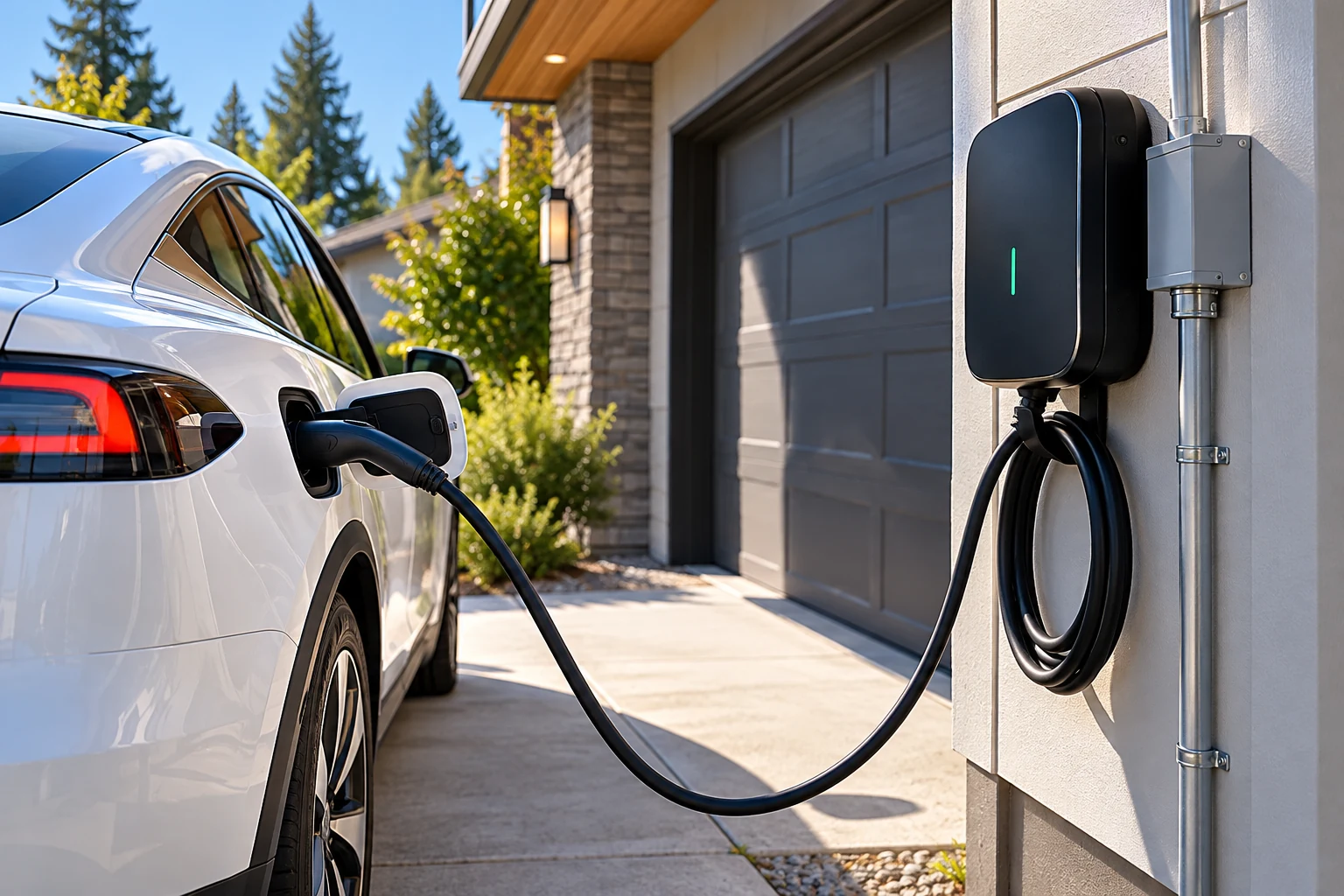
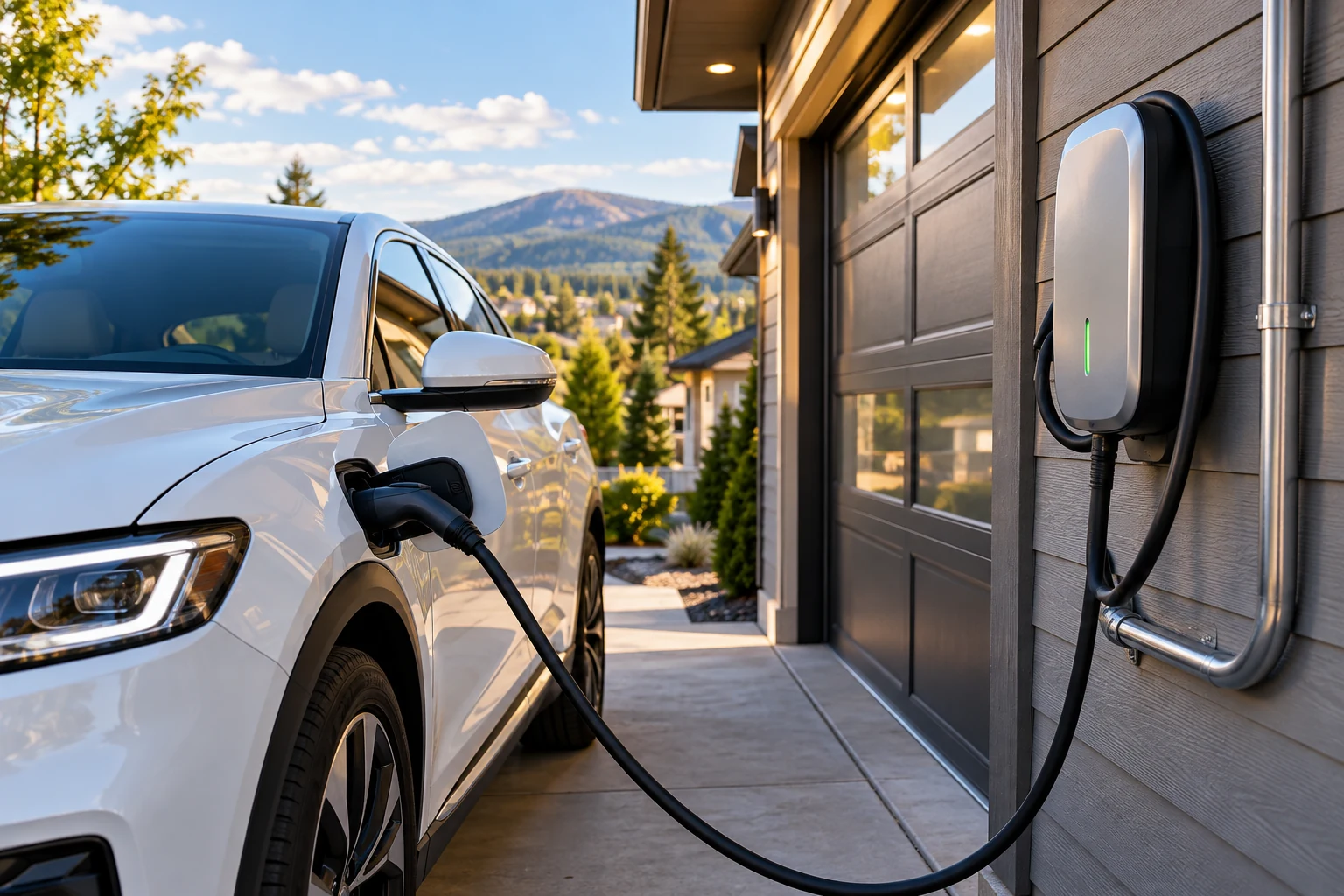
Upgrade your home or commercial property with high-speed 240-volt charging. Replenish 25 to 45 miles of range per hour with hardwired 48A continuous power, turnkey City of Spokane electrical permits, and full Avista rebate capture.
Fixed upfront pricing & Avista rebate verification
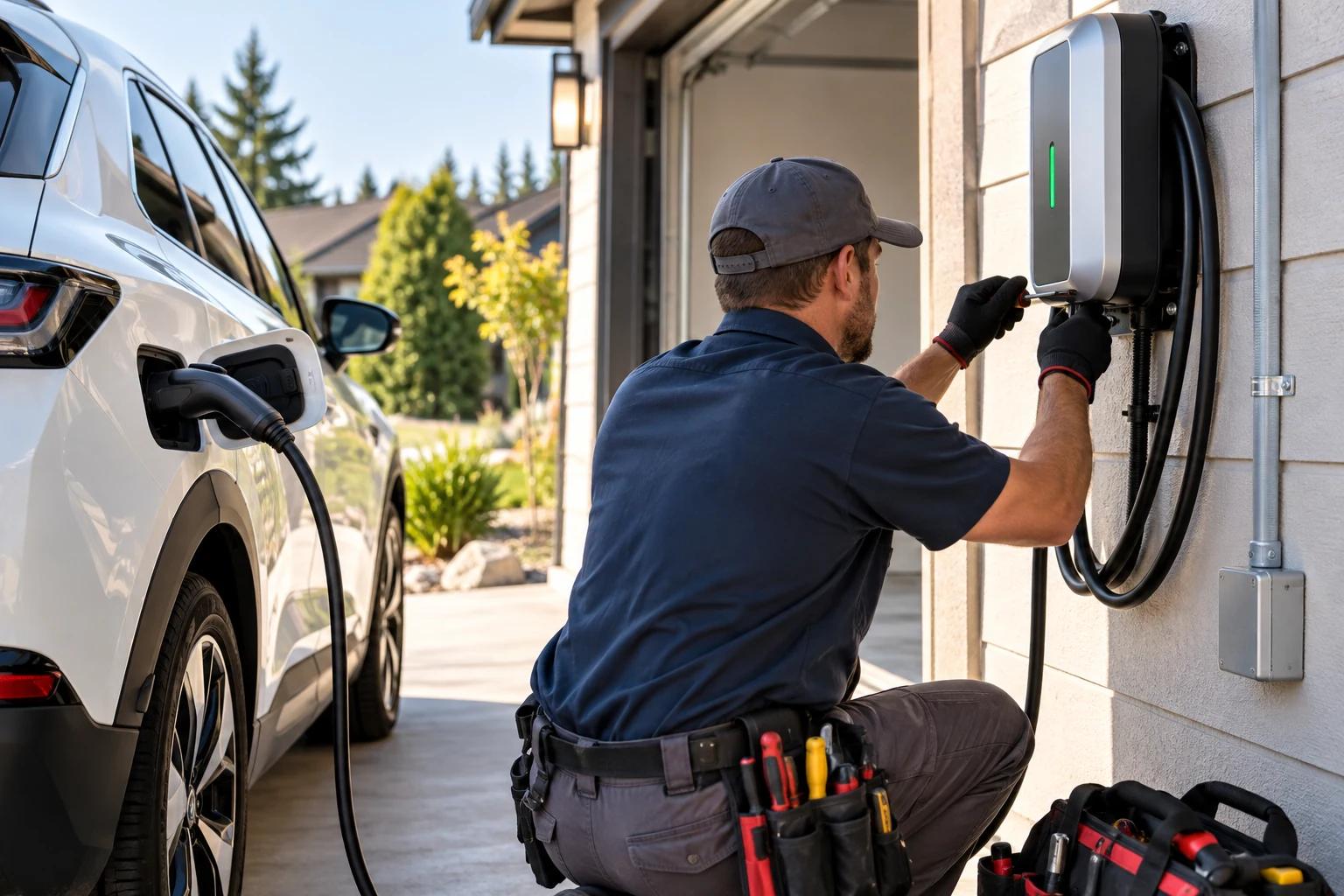
Replenish 25 to 45 miles of range per hour. Experience seamless overnight turnaround and total freedom across Spokane, the South Hill, and the greater Inland Northwest.
Driving an electric vehicle across the Inland Northwest is an exceptional experience, offering instant electric torque on icy hill climbs, quiet highway cruising along Interstate 90, and dramatic fuel savings. However, the true convenience, freedom, and practicality of electric vehicle ownership depend entirely on having a high-speed, reliable Level 2 charging station installed at your Spokane home or business.
Attempting to charge a modern long-range electric vehicle using the standard 120-volt emergency charging cord (Level 1) provided by vehicle manufacturers is an exercise in frustration. Adding a meager 2 to 4 miles of range per hour of charging means a full battery recharge can drag out over 40 to 60 continuous hours. During Spokane's freezing winter months, extreme cold temperatures can halt Level 1 charging entirely.
A dedicated 240-volt Level 2 charging station solves this bottleneck permanently. Delivering between 7.2 kW and 11.5 kW of clean electrical power, Level 2 charging replenishes 25 to 45 miles of driving range per hour. You can return home with an empty battery in the evening, plug in, and wake up every morning to a completely replenished 100% battery pack.
Installing a Level 2 charging station requires professional electrical engineering. Unlike an ordinary household appliance that cycles on and off intermittently, an EV charging station operates as a heavy continuous electrical load, pulling 32 to 48 continuous amperes for hours at a time. This sustained demand places severe stress on residential electrical service panels, circuit breakers, conduit runs, and terminal lugs.
Whether your daily commute involves navigating the steep grades of the South Hill, driving across the Spokane River through Downtown, or commuting to Eastern Washington University in Cheney or across the stateline into Coeur d'Alene, Level 2 charging guarantees your vehicle is always primed for travel.
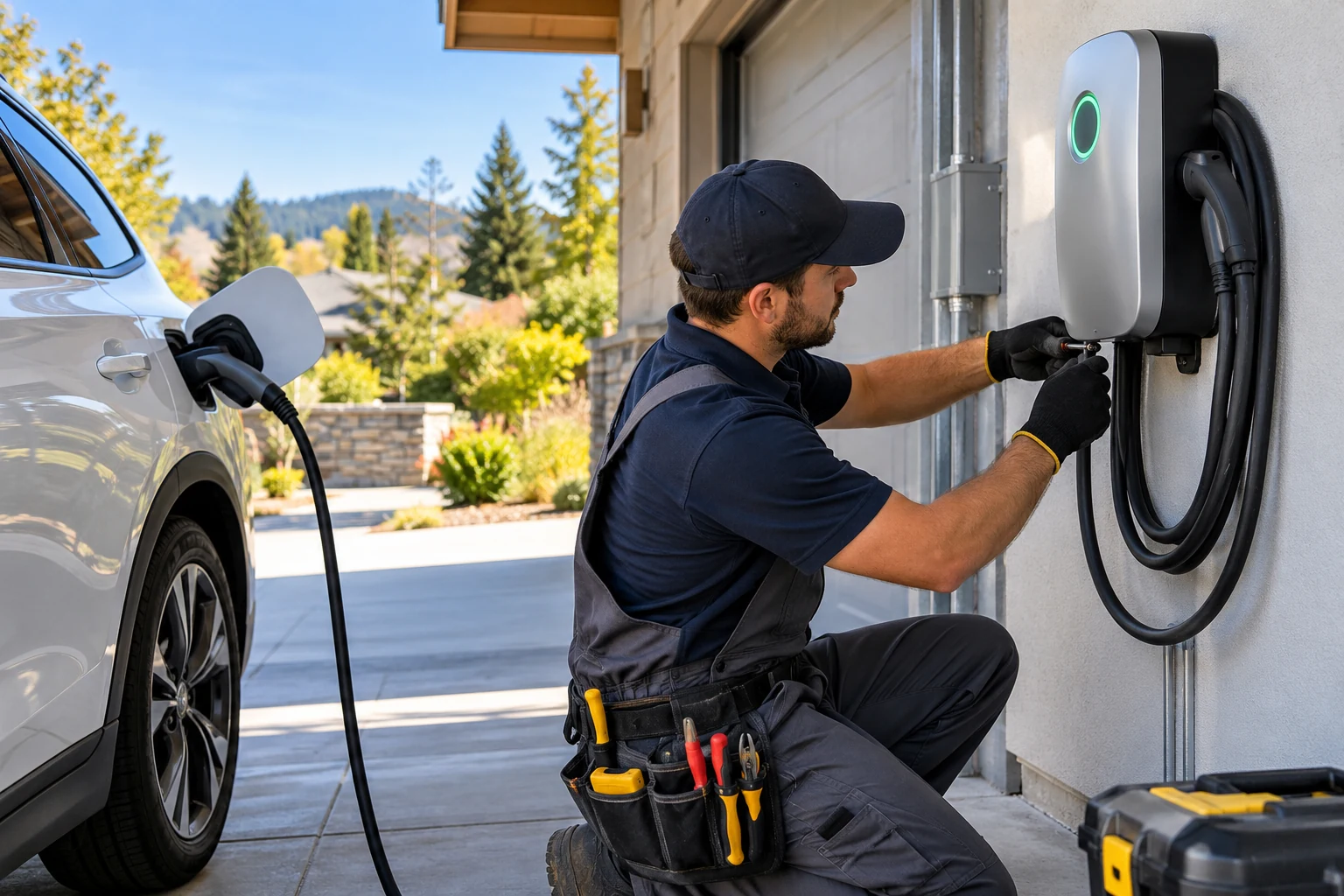
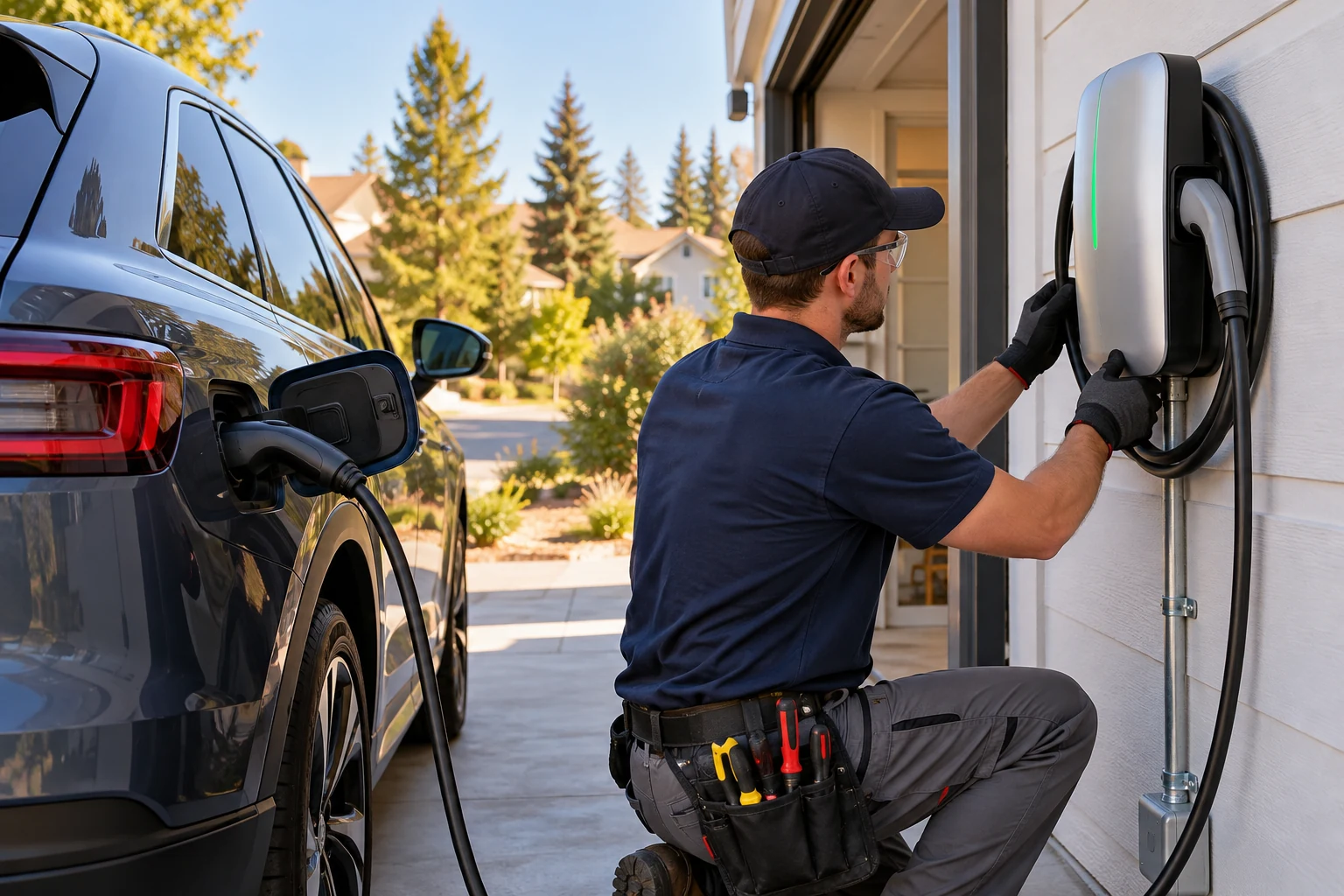
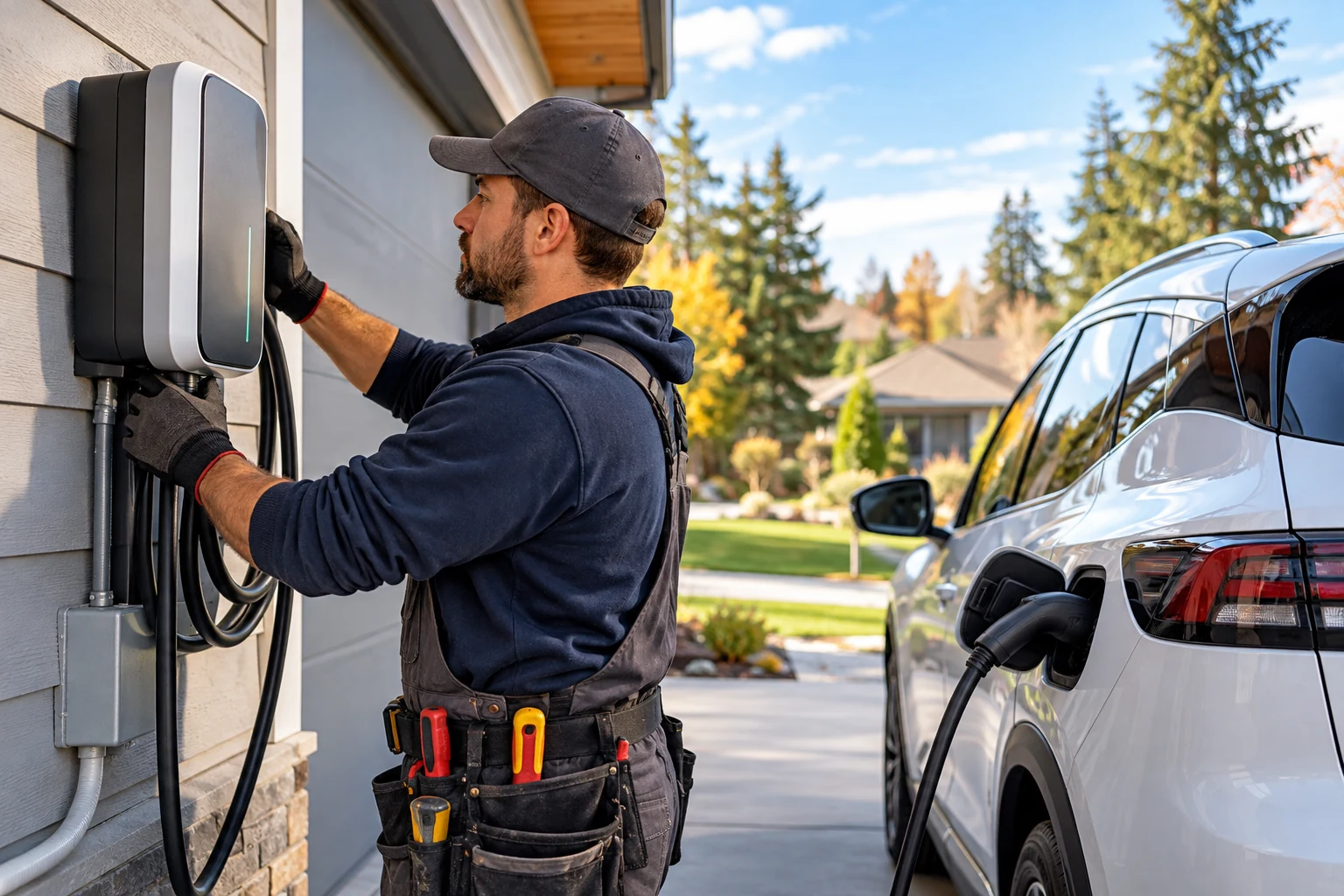
Our dedicated Spokane EV electrical team provides homeowners, commercial property owners, and multifamily facility managers with licensed, insured Washington 01 electrical contractors specializing exclusively in EV infrastructure.
From performing accurate National Electrical Code (NEC) load calculations and upgrading older 100-amp service panels to navigating the City of Spokane's electrical permitting process and capturing regional Avista Utilities rebates, local specialists deliver safe, certified, code-compliant installations engineered to last for the life of your vehicle.
Understanding the mathematical, mechanical, and seasonal differences between 120V emergency trickle cords and dedicated 240V Level 2 charging stations.
Understanding the mathematical, mechanical, and seasonal differences between Level 1 and Level 2 charging clarifies why a 240-volt home installation is essential for Spokane drivers.
A 120-volt Level 1 cord provides an absolute ceiling of 1.4 kilowatts. At that trickle pace, a typical 60 to 75 kWh battery pack requires nearly 3 full days of uninterrupted charging to reach capacity. For anyone driving more than 20 miles per day, Level 1 creates a chronic range deficit.
In contrast, a dedicated 240-volt Level 2 circuit doubles the electrical pressure and quadruples the current, unlocking 7.2 kW to 11.5 kW of continuous power. This allows complete replenishment in just 5 to 7 hours while you sleep during off-peak Avista rate windows.
Spokane winters are characterized by prolonged sub-freezing temperatures, with overnight lows regularly plunging into the teens and single digits between November and February. When an electric vehicle sits parked in an unheated garage or driveway in 15°F weather, its lithium-ion battery pack experiences "cold soaking." Cold lithium-ion chemistry becomes highly resistant to receiving electrical current.
To protect cells from permanent damage caused by lithium plating, the internal Battery Management System (BMS) activates thermal heating loops before allowing current to enter. A 120V outlet supplies only 1.2 to 1.4 kW. Below freezing, the battery’s heating system consumes nearly 100% of that power simply staying warm. Spokane EV owners wake up to find only 4 to 6 miles gained after 11 hours of charging.
A Level 2 installation delivering 7.7 kW to 11.5 kW provides ample electrical headroom to power the battery thermal management system while simultaneously charging the vehicle at full speed.
Furthermore, Level 2 power allows drivers to utilize Preconditioning. Through your smartphone app, you can command your vehicle to warm its battery and heat the cabin to 70°F while still connected to home grid power. Because the energy to melt windshield ice and heat your seats comes from your home electrical panel rather than your battery, you preserve 100% of your rated driving range for your morning commute down the Division Street corridor or across Interstate 90.
| Technical Specification | Level 1 (Emergency Trickle) | Level 2 (Dedicated 240V Branch) | Practical Impact on Spokane Drivers |
|---|---|---|---|
| Electrical Voltage | 120 Volts AC (Standard Household Outlet) | 208V – 240 Volts AC (Dedicated Branch Circuit) | Level 2 doubles the electrical pressure, enabling quadruple the power delivery. |
| Current Amperage | 12 Amps to 15 Amps | 16 Amps to 48 Amps (Continuous Duty) | Level 2 circuits are engineered with heavy-gauge copper to handle continuous current safely. |
| Power Output (Kilowatts) | 1.0 kW – 1.4 kW | 3.8 kW – 11.5 kW | An 11.5 kW Level 2 unit delivers up to 8 times more energy per hour than Level 1. |
| Miles Added Per Hour | 2 to 4 miles of range per hour | 22 to 45 miles of range per hour | A 30-mile daily Spokane commute takes 10+ hours on Level 1, but just 45 minutes on Level 2. |
| Full Recharge Time (60 kWh) | 45 to 60+ hours | 5 to 7 hours | Level 2 provides full overnight charging while you sleep during off-peak utility hours. |
| Cold-Weather Performance | Severe failure risk below 20°F | Full charging speed maintained | Level 2 easily overcomes cold-temperature resistance and powers vehicle preconditioning. |
The market offers dozens of Level 2 charging stations, ranging from basic plug-in units to networked smart chargers. Choosing the ideal EVSE requires evaluating your vehicle’s onboard converter limits, property electrical infrastructure, and charging habits.
A common misconception among new EV owners is that a higher-output charging station will automatically charge any vehicle faster. In reality, the charging station merely acts as a safe power conduit; the actual conversion from alternating current (AC) to direct current (DC) occurs inside the vehicle's onboard charger. Many plug-in hybrids (like the Toyota RAV4 Prime) accept a maximum AC input of 32 amps (7.7 kW). Modern all-electric vehicles (Tesla Model Y/3/S/X, Ford F-150 Lightning, Rivian R1T/R1S, Hyundai Ioniq 5/6, Kia EV6) feature robust 48-amp (11.5 kW) onboard chargers requiring a dedicated 60-amp circuit. For massive 130–200 kWh battery packs, 48A hardwired power is essential to avoid 20+ hour recharge cycles.
Tesla’s flagship 3rd Generation Universal Wall Connector is the premier home charging station for multi-vehicle households. It features an integrated, motorized J1772 "Magic Dock" adapter permanently built into the handle, allowing seamless, one-handed charging for both native Tesla NACS vehicles and standard J1772 vehicles (Ford, Hyundai, BMW, Rivian, VW) without aftermarket adapters.
ChargePoint is an industry gold standard in commercial and residential charging. The Home Flex offers flexible amperage settings adjustable from 16 amps up to 50 amps. Its smartphone app provides industry-leading utility rate scheduling, seamlessly calculating the exact dollar cost of every charging session based on current Avista electric tariffs.
Engineered and manufactured in Canada, the Grizzl-E Classic is a virtually indestructible Level 2 charger built specifically for extreme sub-zero climates. Housed in a heavy cast-aluminum NEMA 4 watertight enclosure, it is fire-resistant, crush-proof, and rated to operate down to -40°F (-40°C) with physical internal DIP switches.
The Emporia Smart Level 2 charger provides top-tier 48-amp hardwired performance at a highly competitive price point. When paired with the Emporia Vue home energy monitor, the system dynamically modulates its charging speed based on whole-home electrical demand or solar panel generation, pausing charging when household appliances spike to protect 100A panels.
Electric vehicle charging equipment is legally classified as a continuous electrical load. Branch circuit conductors and circuit breakers must be sized at 125% of the continuous charging current.
The primary technical standard governing Level 2 EV charging is National Electrical Code (NEC) Article 625. Electrical code explicitly mandates that electric vehicle charging equipment is classified as a continuous electrical load.
A continuous load is defined as any electrical load where the maximum current is expected to continue for three hours or longer. Under NEC Section 625.42 and Section 210.20, branch circuit conductors and overcurrent protective devices (circuit breakers) must be sized at 125% of the continuous load.
This 125% rule (or 80% continuous duty rating) prevents thermal fatigue and premature circuit breaker tripping during 8-hour overnight charging cycles in Spokane garages.
| Continuous Amperage | Breaker Size (125%) | THHN in Conduit (75°C) | Romex NM-B (60°C Derated) | Power (@ 240V) | Miles / Hour | Connection Method |
|---|---|---|---|---|---|---|
| 16 Amps | 20 Amp Double-Pole | #12 AWG Copper | #12 AWG Romex | 3.8 kW | 12 – 15 miles | Plug-in (NEMA 6-20) or Hardwired |
| 24 Amps | 30 Amp Double-Pole | #10 AWG Copper | #10 AWG Romex | 5.8 kW | 18 – 22 miles | Plug-in (NEMA 14-30) or Hardwired |
| 32 Amps | 40 Amp Double-Pole | #8 AWG Copper | #8 AWG Romex | 7.7 kW | 25 – 30 miles | Plug-in (NEMA 14-50) or Hardwired |
| 40 Amps | 50 Amp Double-Pole | #6 AWG Copper | #6 AWG Romex (Max 44A) | 9.6 kW | 30 – 38 miles | Max allowed on NEMA 14-50 Plug |
| 48 Amps | 60 Amp Double-Pole | #6 AWG THHN Copper | #4 AWG Romex Required | 11.5 kW | 40 – 48 miles | Must Be Hardwired (No Plugs Allowed) |
A common, dangerous mistake made by inexperienced handymen involves wiring a 48-amp Level 2 charger using standard #6 AWG Romex (NM-B non-metallic sheathed cable). Under the NEC, individual copper conductors pulled through metal conduit (THHN/THWN-2) are evaluated under the 75°C temperature column, rating #6 AWG copper for 65 amperes (safely accommodating a 60-amp breaker). However, Romex cable (NM-B) is legally restricted by NEC Article 334.80 to the 60°C temperature column, which limits #6 AWG Romex to a maximum of 55 amperes. Connecting #6 Romex to a 60-amp breaker to support a 48-amp EV charger violates Washington State electrical code. Under prolonged 48-amp continuous heating, the internal paper and PVC sheath inside the Romex cable can degrade, melt, and trigger electrical fires within wall cavities. When running Romex for a 48-amp charger, code mandates stepping up to heavy #4 AWG Romex.
Before installing a Level 2 charging circuit, a certified electrician must evaluate your property's electrical service capacity. In Spokane, residential panels typically fall into older 100A panels and modern 200A systems.
An electrical service panel’s availability cannot be determined simply by looking for an open physical slot on the panel door. Electricians perform a mathematical NEC Article 220 demand load calculation.
This calculation tallies square footage (general lighting and receptacle load at 3 VA/sq ft), small appliance branch circuits, nameplate ratings of fixed major appliances (range, oven, water heater, dryer, heat pump), and specialized loads like hot tubs or well pumps.
Once existing demands are factored with standard diversity percentages, the remaining amperage headroom reveals whether the panel can absorb an additional 30A to 60A continuous EV load.
The ultimate long-term solution. The contractor coordinates with Avista Utilities to replace the overhead service drop or underground lateral, install a new heavy-duty 200A meter base, and mount a modern 40-circuit distribution panel.
Future-proofs your home for heat pumps, solar arrays, and multiple electric vehicles.
If upgrading the service panel is cost-prohibitive or restricted by utility easements, an intelligent EMS (like a DCC-9 or Span) continuously monitors total household power draw.
Temporarily pauses the Level 2 charger if home demand approaches 80%, restoring charging automatically when loads drop.
Smart chargers (Tesla Wall Connector, ChargePoint) allow technicians to configure the internal charging current to a lower threshold (such as 24A on a 30A breaker or 16A on a 20A breaker) via internal software switches.
Safely accommodates a 100-amp panel while still delivering 18–22 miles per hour of overnight charging.
During home surveys across mid-century Spokane neighborhoods, electricians occasionally discover obsolete electrical panels that pose extreme fire hazards:
Most insurance carriers refuse to insure properties with active FPE or Zinsco panels. If your home has one of these panels, licensed contractors mandate replacing the panel before connecting a continuous EV load.
When planning a Level 2 installation, homeowners must choose between a permanently hardwired charging station and a 240-volt plug-in receptacle (most commonly a NEMA 14-50 outlet). While both provide 240V power, hardwiring has emerged as the definitive industry gold standard.
| Feature / Consideration | Hardwired Level 2 Installation | Plug-In Installation (NEMA 14-50 Outlet) | Detailed Engineering Analysis |
|---|---|---|---|
| Maximum Charging Rate | 48 Amps (11.5 kW) | 40 Amps (9.6 kW) Maximum | Hardwired connections utilize 60A breakers, delivering 20% faster charging than plug-in units. |
| GFCI Breaker Requirement | Standard Breaker (Charger has built-in GFCI) | Mandatory GFCI Breaker ($120–$180 cost) | 2023 NEC 210.8(A) mandates GFCI breakers for all garage receptacles. Dual GFCI causes nuisance tripping. |
| Physical Failure Points | Zero plug prongs; sealed direct wiring | Prongs, receptacle blades, wire terminals | Plug blades expand and contract under daily 40A heating, leading to loose contacts and terminal melting. |
| Outdoor Weatherproofing | NEMA 3R / 4X rated weather-sealed entry | Requires bulky in-use weatherproof box | Outdoor plugs can admit wind-driven snow and moisture, triggering internal ground faults. |
| Portability & Relocation | Requires electrician to disconnect | Unplug and take charger with you | Plug-in units offer portability for renters or homeowners who plan to move within 1 to 2 years. |
Hardwiring eliminates the mechanical connection points of a 50-amp plug. The copper conductors connect directly from the dedicated breaker into the charger's heavy-duty internal terminal lugs.
Crucially, hardwiring eliminates the severe nuisance tripping issue caused by "double-GFCI" interaction (where a GFCI circuit breaker conflicts with the charger's internal self-testing GFCI electronics), ensuring flawless charging every single night.
If a NEMA 14-50 receptacle is selected, professional electricians strictly install industrial-grade receptacles (such as Hubbell HBL9450A or Bryant 9450FR).
Standard $12 builder-grade outlets (commonly found in big-box home improvement stores) are designed for clothes dryers that cycle on and off for 45 minutes. When subjected to continuous 32A to 40A EV charging for 8 continuous hours, cheap metal contacts overheat, melt the plastic faceplate, and cause severe electrical fires.
Every residential property presents a unique layout. Positioning your Level 2 charging station requires balancing vehicle parking habits, charging cord reach, electrical conduit pathways, and physical protection.
An attached garage provides the simplest, most cost-effective installation environment. If the main electrical panel is located inside the garage, surface-mounted Electrical Metallic Tubing (EMT) conduit can be cleanly routed across drywall or studs directly to the charger mounting plate. Keeping the charging unit indoors shields hardware from Spokane's freezing winter weather and blowing snow, ensuring the charging cable remains supple and easy to handle.
When garage space is unavailable or used for workshop storage, Level 2 chargers can be mounted on the exterior siding of your home or on a freestanding pedestal adjacent to your driveway. Exterior installations require NEMA 3R or NEMA 4 weatherproof enclosures, heavy-duty liquid-tight conduit or rigid PVC, and tamper-proof cable holsters. Keycard (RFID) or smartphone-authorized charging protects your station from unauthorized power draw.
Spokane's South Hill, Manito, Cliff/Cannon, and Five Mile Prairie neighborhoods feature hundreds of historic homes with detached carriage houses and garages. Supplying 240V power requires trenching an underground conduit run from the main home across the yard. In Spokane, excavators frequently hit impenetrable basalt rock ledge 6 to 12 inches below the surface. Specialized diamond rock-saws and mini-excavators are utilized to achieve Washington code-mandated burial depths (24" for PVC, or 6" in solid rock using Rigid Metal Conduit).
Under NEC Section 225.30, a residential building or detached structure can only be served by a single branch circuit or feeder. If the detached garage already has a 120V 15-amp lighting circuit, electricians cannot simply pull a second 240V circuit. Code mandates decommissioning the old circuit and installing a new 60A to 100A detached subpanel, with two dedicated 8-foot copper ground rods spaced at least 6 feet apart to satisfy grounding requirements.
With temperature swings from -15°F in winter to 105°F in summer, Schedule 40 and 80 PVC conduit expands and contracts dramatically (over 4 inches per 100 feet of run). Certified Spokane electricians install telescoping expansion fittings where conduit transitions from underground trenches to above-ground garage walls, preventing sheared fittings and exposed high-voltage wiring.
Spokane winters are demanding on battery electric vehicles. To maintain peak charging performance and battery health, your home Level 2 installation should incorporate cold-weather engineering best practices.
When temperatures plummet across Eastern Washington, lithium-ion battery chemistry slows down significantly. Cold electrolytes resist electron flow, reducing regenerative braking and slowing charging acceptance rates.
A dedicated 240V Level 2 charging station provides the essential wattage required to power internal battery thermal heaters, warm battery coolant loops, and charge your vehicle at full speed regardless of outdoor temperatures.
By pairing proper cold-weather hardware with automated smart charging routines, Spokane EV drivers completely eliminate cold-weather range anxiety and wake up to a warm, defrost-ready car every morning.
Standard consumer-grade charging cables utilize polyvinyl chloride (PVC) outer jackets. When temperatures drop below 20°F, PVC plastic stiffens into rigid, unyielding coils. Attempting to bend a frozen PVC cord in a 10°F Spokane garage feels like wrestling a solid garden hose.
High-grade stations (ChargePoint Home Flex, Grizzl-E Classic, Tesla Wall Connector) utilize specialized thermoplastic elastomer (TPE) or premium synthetic rubber jackets rated to remain flexible down to -40°F (-40°C), making handling, coiling, and holster docking effortless all winter long.
Take advantage of "Scheduled Departure" in your vehicle or charger smartphone app. Rather than allowing your battery to finish charging at 2:00 AM and sit freezing for 5 hours, configure your charging session to complete 30 minutes before your morning commute.
The natural heat generated by the chemical charging process leaves the battery pack thoroughly warm when you unplug. Combining this with 15 minutes of grid-powered cabin preconditioning preserves your battery's full kilowatt-hour capacity for driving.
Performing unpermitted electrical work in Washington State violates state law (RCW 19.28), voids manufacturer warranties, and gives insurance companies legal grounds to deny coverage if an electrical fire occurs. Licensed electrical contractors manage 100% of the permit process.
Authority: City of Spokane Development Services Center (808 W Spokane Falls Blvd).
Governing Code: Spokane Municipal Code (SMC) Section 17F.050.020 adopts the National Electrical Code with local city amendments.
Inspectors verify circuit sizing, wire gauge, torque markings, and dedicated disconnects.
Authority: City of Spokane Valley Building & Permits Department (10210 E Sprague Ave).
Jurisdiction: Covers all residential and commercial addresses within the incorporated city limits of Spokane Valley.
Coordinates electrical permit filings and final on-site physical inspections.
Authority: Washington State Department of Labor & Industries (L&I) Electrical Division.
Jurisdiction: Unincorporated Spokane County, Liberty Lake, Cheney, Medical Lake, Airway Heights, and Deer Park.
State electrical inspectors conduct both rough-in and final signed safety sign-offs.
Under Spokane Municipal Code 17F.050.020, city inspectors verify that circuit breaker terminals and lug screws are torqued precisely to manufacturer inch-pound specifications using calibrated torque screwdrivers (NEC 110.14(D)). Inspectors also verify that conductors are properly derated for temperature and raceway fill, that all outdoor hardware is rated NEMA 3R or NEMA 4X, and that emergency disconnects are accessible within sight of the charger for commercial or multifamily applications.
Project transparency is essential for Spokane homeowners planning an EV charger upgrade. Because residential wire distance, panel capacity, and architectural layouts vary, installation costs fall across several distinct tiers.
| Project Scope Tier | Labor & Materials Cost | Scope Details & Included Work | Common Local Variables |
|---|---|---|---|
| Tier 1: Standard Garage Installation (Short Run) | $550 – $1,100 | Dedicated 40A–60A breaker, up to 15 ft of surface-mounted EMT conduit, #6 AWG copper, charger mount, wiring & testing. | Main panel located inside the garage with adequate existing amperage capacity. |
| Tier 2: Finished Basement / Extended Run | $1,100 – $1,800 | Longer conduit runs (25–60 ft) routed through finished basement ceilings, crawl spaces, or exterior brick walls. | Fishing wire through drywall, core drilling exterior masonry, or minor drywall patching. |
| Tier 3: Detached Garage & Basalt Trenching | $1,800 – $3,600+ | Underground trenching, 24" direct burial PVC or RMC conduit, pulling heavy feeder wire, subpanel installation. | Trench length (30–100+ ft), navigating basalt rock ledge on South Hill, lawn restoration. |
| Tier 4: 200A Electrical Service Panel Modernization | $2,800 – $4,500 | Replacing older 100A panel with modern 200A 40-circuit panel, new meter base, Avista service coordination. | Upgrading obsolete Federal Pacific or Zinsco panels, moving meter socket location. |
| Permitting Authority | Residential EV Circuit Permit Fee | Service Panel Upgrade Permit Fee | Typical Approval Turnaround |
|---|---|---|---|
| City of Spokane Development Services | $110 – $185 | $220 – $340 | 1 to 3 Business Days (Online Contractor Portal) |
| City of Spokane Valley Building Dept | $95 – $160 | $200 – $310 | 2 to 4 Business Days |
| Washington Department of Labor & Industries (L&I) | $115 – $190 | $230 – $360 | 1 to 2 Business Days |
Spokane homeowners and commercial operators can leverage regional, state, and federal incentive programs to substantially offset the upfront cost of Level 2 charging infrastructure.
Under Washington’s Clean Energy Transformation Act (CETA), Avista administers electric vehicle charging programs for Eastern Washington customers.
Qualifying residential customers can receive equipment rebates for smart, networked Level 2 chargers, with enhanced rebates (up to $1,000) for income-qualified households.
Under RCW 82.08.816 and RCW 82.12.816, Washington State provides a sales and use tax exemption on Level 2 and DC fast-charging infrastructure.
This exemption covers both the physical charging station hardware and the certified electrician labor costs required to install the dedicated circuit.
The federal Alternative Fuel Vehicle Refueling Property Credit provides an IRS tax credit of up to 30% of total hardware and installation costs (maximum $1,000 for residential properties).
Applies to properties located in eligible non-urban and low-income census tracts across Spokane County.
While internet videos suggest running high-voltage wiring is simple, installing a continuous high-voltage electrical branch circuit is fundamentally different from replacing a light switch or fixture.
Electric vehicle charging stations represent the single largest continuous electrical load in modern residential homes. A continuous draw of 32 to 48 amperes running for 8 continuous hours generates significant thermal heat within electrical conductors and terminal screws.
Improper wire stripping, inadequate torque on circuit breaker lugs, or undersized conductors can cause rapid thermal runaway, arcing, and catastrophic structure fires.
Washington State law (RCW 19.28) strictly mandates that all major electrical installations must be permitted and inspected. Licensed electrical contractors carry liability insurance, provide warranty guarantees, and ensure 100% code adherence.
The #1 cause of electrical fires in home EV setups is loose terminal screws. Under NEC 110.14(D), electricians must torque every connection using calibrated torque tools to manufacturer-specified inch-pounds.
DIY handymen frequently route #6 Romex on a 60A breaker, violating NEC 334.80 60°C derating. Over continuous hours, internal insulation degrades and melts within closed wall cavities.
Unpermitted electrical work gives homeowners insurance carriers valid legal grounds to deny claims in the event of an electrical fire. Licensed permits protect your home equity.
Even properly installed Level 2 chargers require basic awareness of electrical safety and operational diagnostics. If you encounter charging interruptions, consult these expert diagnostic protocols.
Ground Fault Detection: All certified Level 2 chargers contain sensitive internal Ground Fault Circuit Interrupter (GFCI) hardware. If moisture enters the charging handle or there is electrical leakage along the vehicle charging port, the unit halts power delivery instantly to protect against shock hazards. Inspect the handle connector for moisture or debris, cycle the breaker, and retry.
Line Voltage Sag: If household voltage drops below 208V during extreme winter cold snaps when grid demand spikes, smart chargers will enter a protective fault state. If red error lights persist, an electrician will test circuit resistance and ground integrity.
Normal vs. Excessive Warmth: A 240V circuit operating at 32A to 40A will naturally feel warm to the touch (up to 120°F is standard). However, if the outlet faceplate feels uncomfortably hot (above 140°F), discolored, warped, or produces an ozone / burning plastic smell, you are experiencing high-resistance thermal overheating.
Emergency Protocol: Immediately halt charging via your vehicle app, unplug the cable, shut off the dedicated double-pole breaker inside your panel, and call a certified electrician to replace the receptacle with an industrial-grade Hubbell or Bryant unit.
Living in a condominium, townhome, or apartment community in Spokane historically made installing a home EV charger difficult due to restrictive Homeowners Association (HOA) covenants. Fortunately, Washington State law protects tenant and owner rights.
Under Washington State law (RCW 64.34.442 and RCW 64.38.060), condominium associations and HOAs cannot prohibit or unreasonably restrict a unit owner from installing an electric vehicle charging station within their designated parking stall.
While associations may establish reasonable aesthetic and safety architectural guidelines, they cannot arbitrarily deny a compliant installation request.
Our commercial electrical team works directly with Spokane HOA boards and property managers to draft engineering proposals, install submetering solutions, and execute safe installations in shared garages.
RCW 64.34.442 mandates that HOA boards must process EV charging requests in the same manner as architectural modifications. The unit owner agrees to hire a licensed electrical contractor, pay for installation and electricity usage, and maintain appropriate liability insurance.
For community garages with limited panel headroom, contractors install networked Level 2 chargers equipped with Open Charge Point Protocol (OCPP). This enables automated credit card billing, individual user authentication, and intelligent dynamic load-sharing across stalls.
Everything you need to know about 240V circuits, equipment sizing, city permitting, winter charging, and costs in Spokane, WA.
Speak directly with a licensed Washington 01 master electrician. We evaluate your panel headroom, calculate Avista utility rebates, and provide transparent fixed-price quotes.
Never compromise on your vehicle's charging speed, battery longevity, or your home’s electrical safety. Connect with authorized, licensed Washington 01 electrical contractors today.
Free Project Consultations · Licensed & Insured Washington 01 Electrical Contractors · Turnkey City Permitting & Avista Rebate Assistance
Complete the details below for a prompt, transparent estimate.